
★★★★★
“Our Designer IT integrated column threw a defrost fault code in our Suburban Park remodel. They told us not to clear it, metered the defrost sensor and heater, and replaced the part for $640 in about two hours.”
Technical reference · Codes & alarms
A flashing service light or alarm on a Menlo Park Sub-Zero means the control board caught a condition — a sensor out of range, a defrost fault, a door ajar, or a wine zone drifting. Codes are read by your model and serial tag, never a generic chart, then confirmed with a meter.
Near Santa Cruz Avenue downtown, where many homes run dual columns, we often see one zone alarm while the other holds fine, which points to a zone-specific sensor rather than the whole control. The code narrows the cause; it does not by itself prove which part failed.
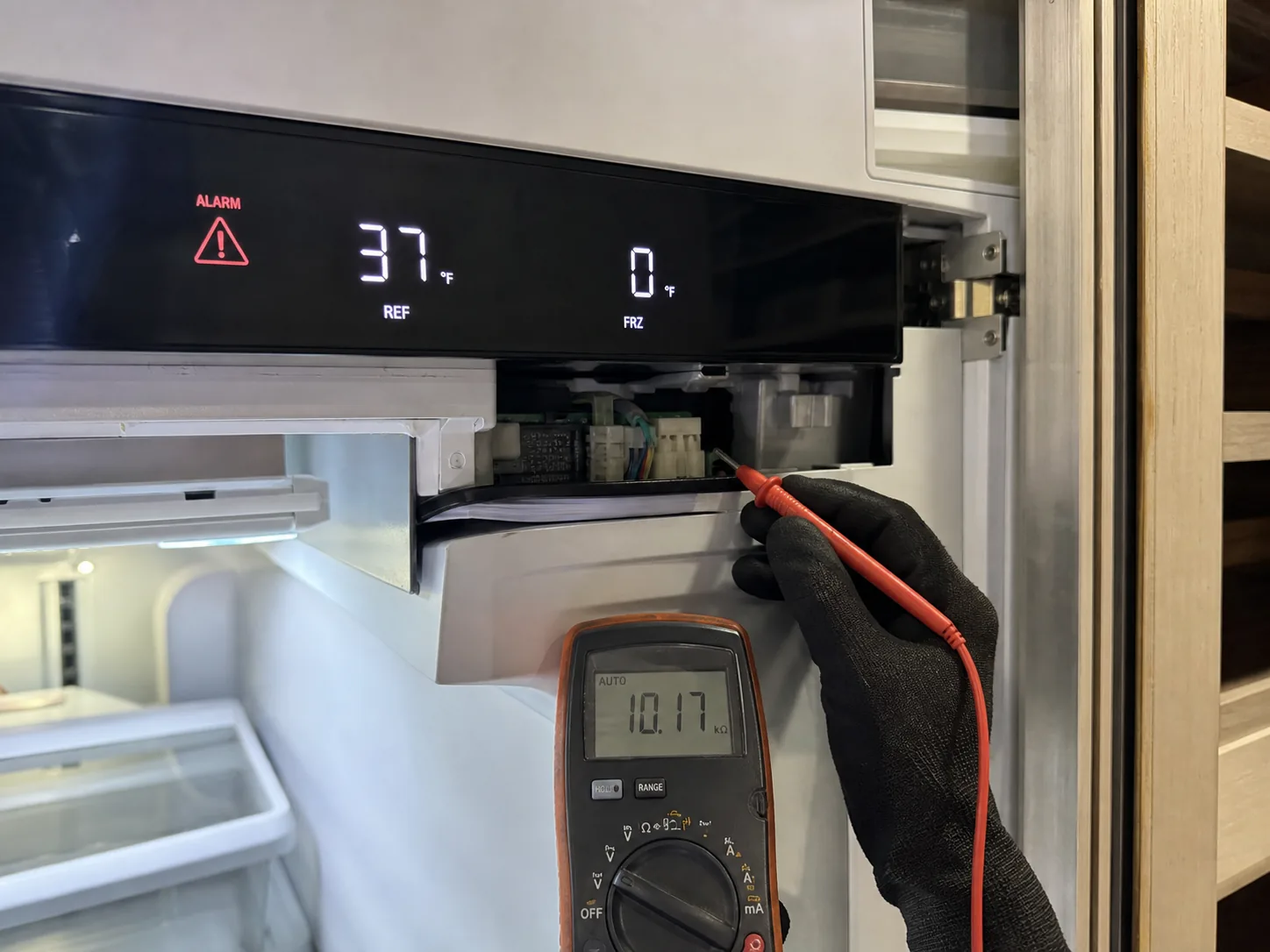
The second thing a code can flag is the control board, thermistor or display itself. A thermistor reading out of range can make a perfectly good compartment alarm; a tired board can throw codes that come and go. What confirms it is a meter on the sensor and the board, not the code alone — and what cannot be known from the code is whether the sensor or the board is at fault until both are tested.
Quick reference
A plain-language list of the Sub-Zero alarms and display behaviors we meet most in Menlo Park kitchens. It is a reasoning aid, not a code dictionary — exact letters and numbers shift by model and serial, so read the real code off your rating plate before acting. We do not assign meanings to invented numbers.
| Alarm / display behavior | What it usually points to | What to do |
|---|---|---|
| Flashing or solid “Service” indicator | A stored fault, sensor input or control-board condition — meaning varies by model family. | Photograph it, leave power on, and verify against your model/serial before any reset. |
| “Vacuum Condenser” reminder or long run times | Condenser packed with dust or pet hair restricting airflow. | Pull the lower grille, check the condenser, and re-probe cycling after a clean. |
| Frost line or condensation at the door edge | Door gasket leak or seal swelling — common where Menlo Park marine fog and bay humidity off Belle Haven work the seals. | Paper-drag test and seal inspection; OEM gasket or hinge adjustment as measured. |
| Over-temp / high-temp alarm after a long door-open | Normal recovery, or a marginal temperature sensor. | Allow a full recovery cycle, then re-probe before replacing a thermistor. |
| Fresh-food warm while the freezer still holds | Evaporator fan, frosted coil or air damper on dual-refrigeration columns — not necessarily the sealed system. | Watch fan rotation and airflow; defrost, fan or damper repair after metering. |
| Blank, frozen or unresponsive display | Control board, ribbon connector or power supply. | Confirm supply voltage; reseat or replace the confirmed board — avoid repeated power-cycling. |
Newer Sub-Zero units may show an EC-style electronic code; the meaning is model-specific, so read it against your model and serial rather than a generic chart. Call (650) 699-5567 before resetting.
The control flagged a condition, not a confirmed part: a thermistor out of range and a tired board look alike, so we meter both and verify the code against your model and serial. Suburban Park owners near 94025 can reach Menlo Park Sub-Zero Repair at (650) 699-5567 to confirm it by meter.
Read this first
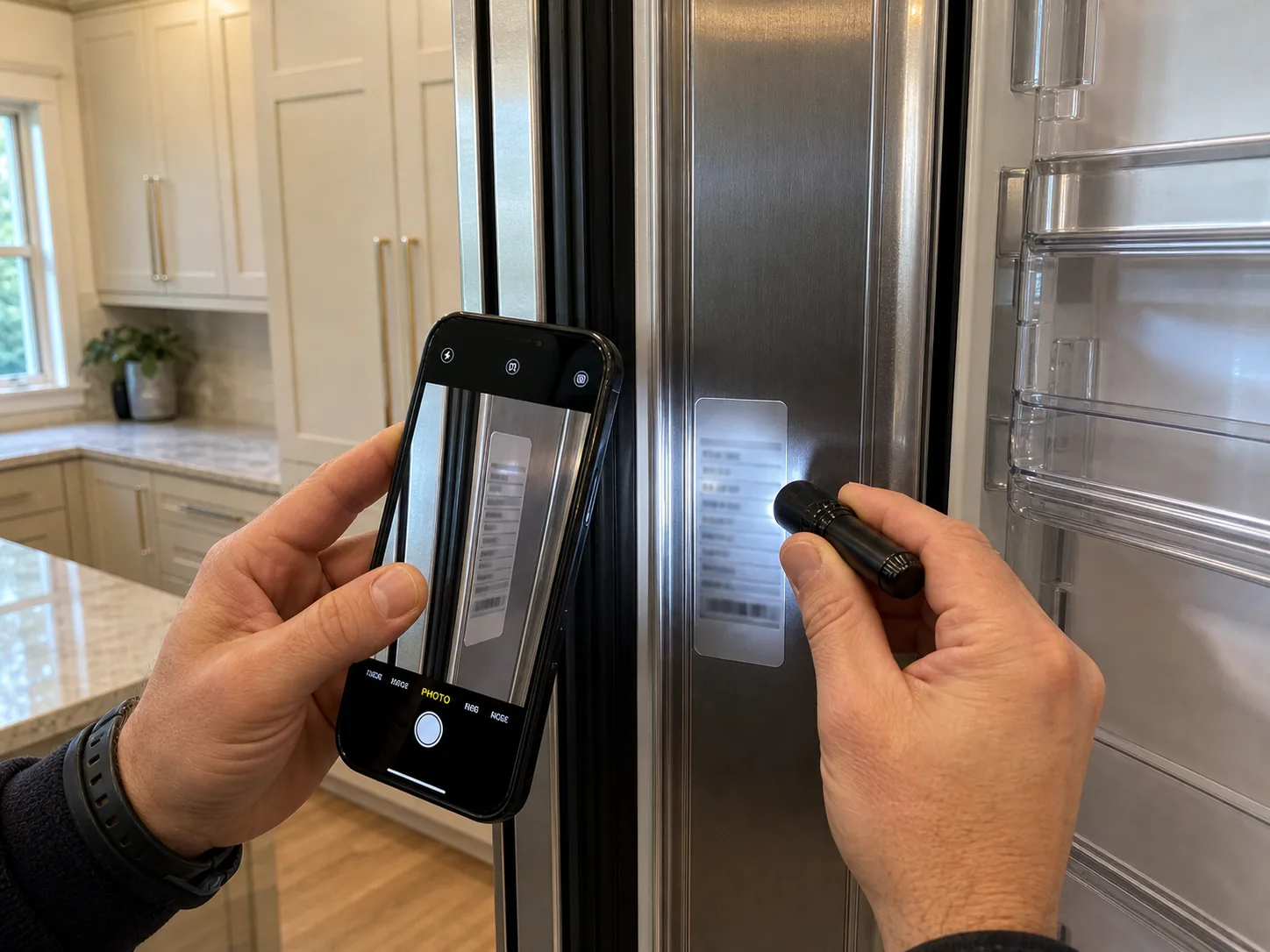
Safe to do yourself: note the exact code and the model number, confirm the door is fully closed, check that the unit has power and the condenser grille isn’t blocked, and write down the displayed temperatures. Leave to a technician: anything involving refrigerant, the sealed system, gas, mains wiring or opening the control board. Do not clear the code repeatedly before a visit — an active fault is far easier to confirm than an intermittent one, and some conditions protect the food load while you wait.
Diagnostic matrix
A general triage map for Sub-Zero refrigeration alarms. Exact code letters and values differ by model and year — always verify against your model and serial; we do not invent code meanings. In Menlo Park, a high-temp or dirty-condenser alarm usually clears with a condenser deep clean ($190–$460); a flashing sensor code more often means a $240–$520 thermistor, not a $380–$950 control board.
| What you see | Possible component | Confirmation test | False positive to avoid | Repair path |
|---|---|---|---|---|
| Compartment alarm, temp high | Evaporator fan / thermistor | Meter fan motor & sensor; read vent temp | Don’t blame compressor on temp alone | Fan or sensor, after metering |
| Persistent frost + alarm | Defrost heater / control | Check defrost cycle & drain | Not always a gasket | Defrost component / drain clean |
| Door / ajar warning | Door switch / alignment | Test switch; check reveal | Not the main board | Switch or door adjustment |
| Wine zone off several degrees | Zone sensor / damper | Compare zone readings | Don’t reset display blindly | Zone sensor / airflow service |
| Intermittent multiple codes | Control / interface board | Meter board outputs | Replacing sensors first wastes money | Board service after confirmation |
| Ice/water alarm | Inlet valve / fill tube | Check water supply & valve | Not the ice module by default | Valve / fill tube repair |
| Both compartments warm | Condenser airflow / sealed system | Inspect coil; pressure test | Don’t assume compressor | Coil clean or EPA sealed-system work |
Model-family notes
If exact code values aren’t verified for your unit, we mark them “verify by model/serial” rather than guess. Near Atherton and the homes by SLAC, where larger estates often run multiple units, matching each alarm to its specific unit and serial is how we avoid chasing the wrong board.
Evidence, not assumption
The proof a technician records: the model tag, the meter or probe reading on the sensor/board, and a component photo. When a fresh-food section is warm while the freezer still holds, the readings tell the story — not the code alone.


Step by step
A short, safe checklist before you book. Doing these six things means the right thermistor, defrost part or board can be on the truck for your Menlo Park visit instead of a return trip.
Alarm type → action → price → time
| Alarm / code type | Usual action | Planning range | Typical time |
|---|---|---|---|
| Diagnostic / code read | On-site code read & meter confirm (credited to repair) | $110–$195 | 30–60 min |
| Sensor / thermistor code | Sensor / thermistor replacement | $240–$520 | 1–2 hr |
| Defrost fault code | Defrost heater / sensor / timer | $320–$720 | 1.5–3 hr |
| Door-ajar / temp alarm | Gasket / alignment or condenser airflow correction | $190–$560 | 1–2 hr |
| Dirty-condenser / high-temp alarm | Condenser deep clean | $190–$460 | 1–1.5 hr |
| Control / communication fault | Control board / user-interface service | $380–$950 | 2–3.5 hr |
In Menlo Park’s 700-series and Designer integrated columns the code narrows the part and the meter confirms it — a flashing sensor code points to a $240–$520 thermistor far more often than a $380–$950 board.
Error code questions
Usually not before a visit. Clearing an active fault makes it harder to confirm, and some alarms protect the contents. Note the code, model number and symptom photos before calling to schedule.
It narrows it. A code flags a condition the control detected; a sensor out of range and a failing board can look similar, so we meter both to confirm.
On dual-refrigeration units the sections cool independently, so a warm fridge with a cold freezer points to the fridge fan, a frosted coil or a damper/sensor fault, not the compressor.
We can often tell you what to check and what parts to expect, but we will not invent a code value for your model. Final confirmation is by meter, verified against your model and serial.
It can. Marine fog and bay humidity load extra moisture onto seals and the defrost system, so a door-ajar or defrost alarm appears more often in foggy stretches. We confirm with the meter; a gasket or airflow fix runs $190–$560 and a true defrost part $320–$720.
It means the unit is running warm, most often from a clogged condenser starving the sealed system of airflow. In Menlo Park that usually clears with a $190–$460 condenser deep clean rather than compressor work, which we only quote after a pressure test confirms it.
Have the exact code and your model number ready and we’ll arrive prepared to confirm it with a meter, not a guess.
Local reviews
Local feedback on model-first diagnosis, clean built-in work and written pricing.
“Our Designer IT integrated column threw a defrost fault code in our Suburban Park remodel. They told us not to clear it, metered the defrost sensor and heater, and replaced the part for $640 in about two hours.”
“Our 700-series built-in flashed a sensor code after a foggy week at our University Heights home. The tech confirmed a thermistor with a meter, not the board, and swapped it for $410 in just over an hour.”
“A high-temp alarm on our Belle Haven 700-series turned out to be a clogged condenser, not the compressor. A $380 deep clean cleared the alarm and the unit has held temperature since.”