
★★★★★
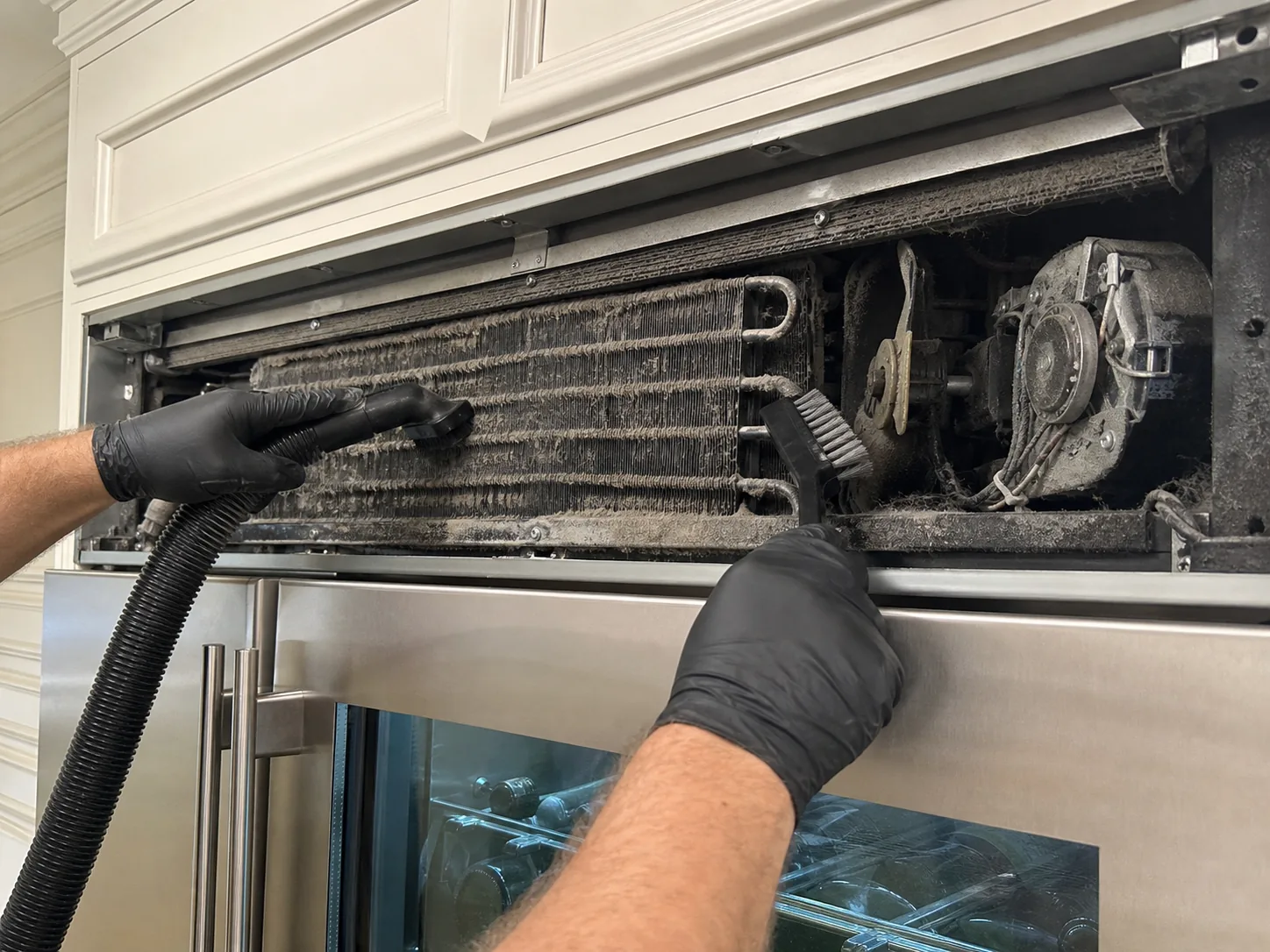
“Our 632 was warm but still running and another shop quoted a compressor. In our Central Menlo Park built-in they ruled out airflow first — a dust-packed condenser. A $260 deep clean fixed it; it was never the compressor.”
Technical · Sealed system & compressor
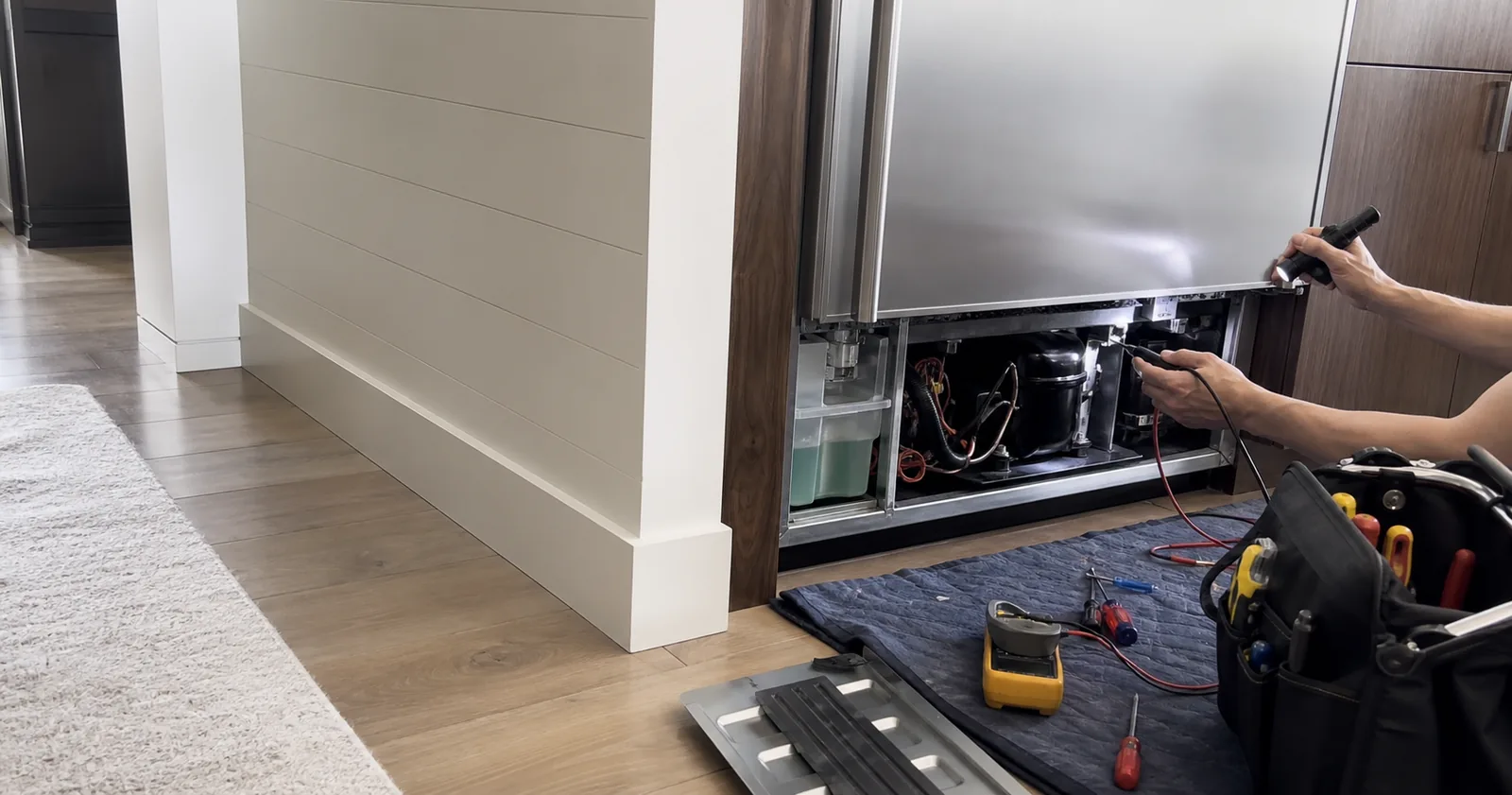
A sealed-system fault is the most serious — and most over-diagnosed — problem on a Sub-Zero. When an ice maker is producing hollow cubes alongside a warming freezer, or both compartments slowly climb, owners often fear the compressor. In Central Menlo Park built-ins the truth is usually less dramatic: airflow, a fan, or a frosted coil. The sealed system — refrigerant, compressor, evaporator and condenser as one closed loop — is only confirmed by pressure testing, never by symptom alone.
It can also masquerade as other faults. A wine column drifting several degrees on a combined unit, or a slow leak, can mimic a control problem. What confirms a sealed-system issue, and what cannot be known from the front panel, is a qualified pressure and recovery test — which is exactly why this is the repair we refuse to guess at.
A warm but running Sub-Zero is rarely the compressor, so we rule out condenser airflow, the evaporator fan and the thermistor first, then prove a refrigerant or compressor fault by pressure and leak testing before any recharge. Sand Hill Road owners near 94025 should phone Menlo Park Sub-Zero Repair at (650) 699-5567.
Safety first
Safe for a homeowner: confirm the condenser grille is clear, the coil isn’t packed with dust, the unit has airflow, and note the temperatures and any code. Not safe and not legal to DIY: anything touching refrigerant or the sealed loop. Refrigerant recovery and recharge require proper refrigerant-handling credentials and proper equipment. Don’t add “refrigerant top-ups” sold online — they can damage the system and mask the leak that needs finding. That requirement attaches to the person, not the shop — here is which Sub-Zero repairs need the EPA 608 card, and which never will.
Diagnostic matrix
The point of this table is to rule out the inexpensive causes before condemning the compressor. Exact values vary by model — verify by model and serial; we do not invent figures.
| Symptom | Possible component | Confirmation test | False positive to avoid | Repair path |
|---|---|---|---|---|
| Both sides slowly warm | Condenser airflow | Inspect/clean coil; recheck | Don’t condemn compressor first | Coil clean — often the whole fix |
| Warm but compressor runs | Evaporator fan | Meter fan motor | Running ≠ cooling | Fan replacement |
| Freezer warm, frost gone | Defrost / sealed system | Check defrost, then pressures | Not always refrigerant | Defrost part or sealed-system work |
| Unit runs constantly, no cooling | Refrigerant leak | Pressure/leak test | No top-ups without leak search | Locate leak, recover, repair, recharge |
| Compressor hot, clicks, won’t start | Compressor / start components | Meter start relay & windings | Could be relay, not compressor | Start components or compressor |
| Oil/refrigerant residue near coil | Leak point | Leak detection | Don’t recharge a leaking system | Seal/replace leak point |
| Intermittent cooling, codes | Control + sealed interaction | Meter board; verify pressures | Replacing board may not fix it | Confirm both before quoting |
Model-family notes
Along the Sand Hill Road corridor and in tightly built West Menlo Park kitchens, restricted condenser ventilation is a frequent reason a perfectly good sealed system looks like it’s failing — which is why we inspect airflow before we ever talk about refrigerant. A coil that gets checked on the maintenance calendar for Menlo Park owners rarely deteriorates far enough to fake a compressor failure.
Manual, not marketing
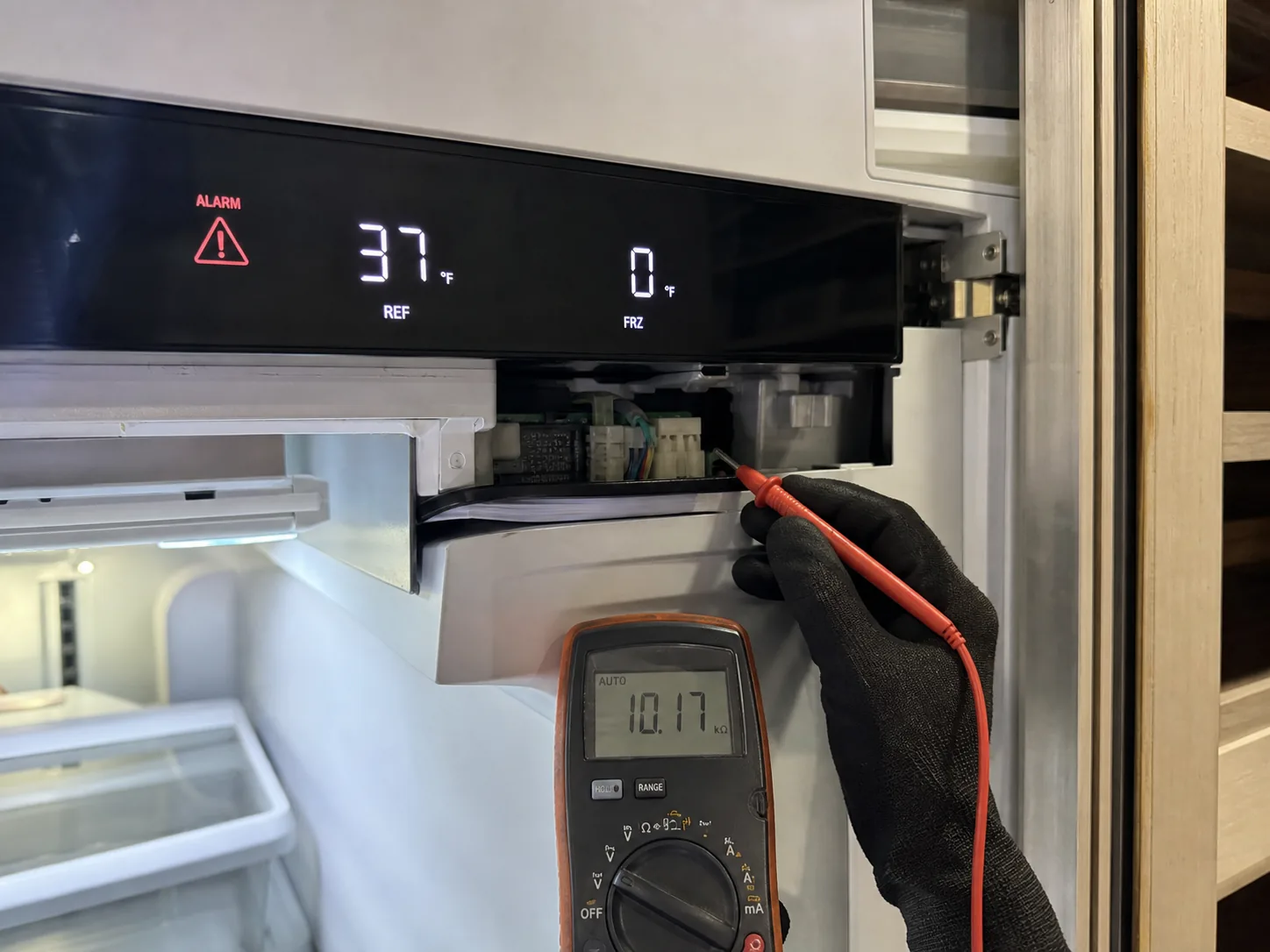
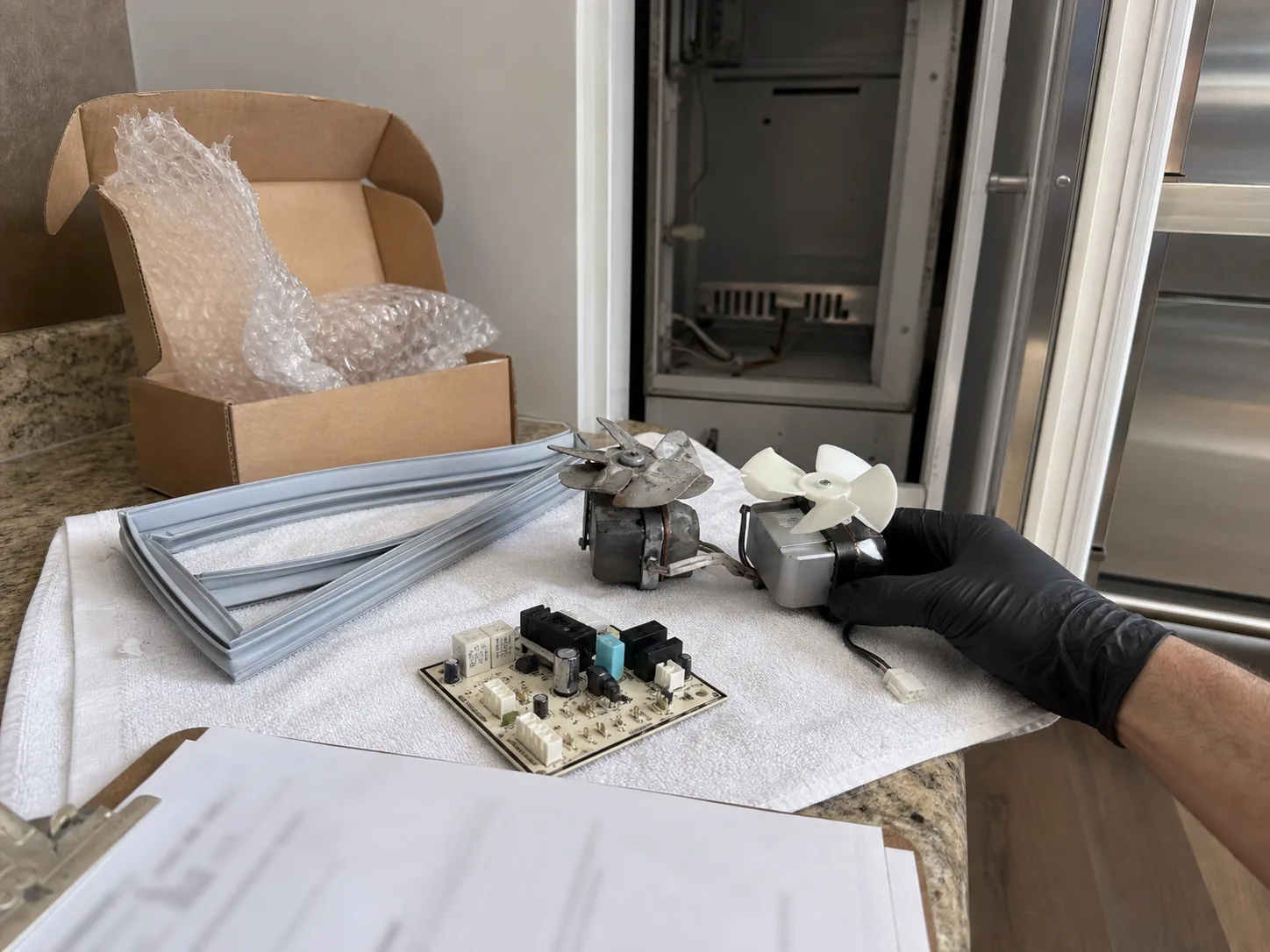
For this repair the documentation is non-negotiable: the model tag, the meter/probe and pressure readings, and a component photo. A control board, thermistor or display alarm is ruled in or out with the same rigor, because replacing a board won’t fix a leak and recharging won’t fix a board.
Step by step
A warm-but-running Sub-Zero in Menlo Park is usually airflow, a fan or a sensor — not the compressor. Sealed-system repair here runs about $650–$2,800 and is only quoted after leak and pressure evidence. These six steps are the order we follow before any refrigerant is touched.
Step -> what’s verified -> price -> time
| Step / repair | What’s verified or done | Planning range | Typical time |
|---|---|---|---|
| Diagnostic visit | On-site temps, codes and pressures read; credited toward an approved repair | $110–$195 | 45–75 min |
| Rule out airflow first — condenser deep clean | Dust-packed coil cleaned and airflow restored before the compressor is ever blamed | $190–$460 | 1–2 hours |
| Electrical test — compressor relay / start components | Start relay and windings metered; start components replaced if that’s the fault | $280–$620 | 1–2.5 hours |
| Refrigerant leak detection & repair | Leak located, recovered and sealed — no recharge over an unfixed leak | $650–$1,400 | 3–6 hours |
| Compressor replacement (verified) | Failure confirmed; EPA-certified recovery and recharge with a new compressor | $1,400–$2,800 | 5–8 hours + parts |
| Evaporator / filter-drier replacement with recharge | Evaporator or filter-drier replaced, system evacuated and recharged to spec | $900–$1,700 | 4–7 hours + parts |
A compressor is never quoted from symptoms in Menlo Park — a warm 632 or 690 in Sharon Heights or Felton Gables is priced only after the airflow, fan, sensor and pressure evidence is in. Full context for every range, including the cheaper non-sealed repairs, sits in the complete Sub-Zero repair pricing guide.
Sealed-system questions
You usually don't from symptoms — a warm, running unit is more often airflow or a fan. A true sealed-system or compressor fault is confirmed by qualified pressure testing and metering the start components.
Not responsibly. A low charge means a leak, and recharging without finding and repairing it just delays failure and wastes refrigerant. We locate the leak, recover, repair, then recharge.
No. A warm but running Sub-Zero in Menlo Park is usually airflow, a fan or a sensor, so no compressor is quoted by phone. We confirm it on-site with pressure and electrical tests first; sealed-system work then runs $650–$2,800 depending on whether it's a leak, evaporator or full compressor.
Often yes if the cabinet is sound and parts are available. On these older 600-series units a verified leak or evaporator repair at $650–$1,700 usually beats replacement, but a discontinued compressor pushing $1,400–$2,800 can tip toward a new unit — see the repair-vs-replace page.
It exposes them more than it kills them. When Menlo Park summer highs reach the 90s°F, a dust-blocked condenser can't shed heat and the unit reads warm, mimicking failure. A $190–$460 condenser deep clean fixes most of these; a true heat-stressed compressor is confirmed by pressures, not the heat wave.
Yes, near Belle Haven and the bay salt-marsh air corrodes condenser coils and accelerates dust buildup, which can mimic a sealed-system fault. We inspect and deep-clean the coil for $190–$460 before testing pressures, so corrosion isn't mistaken for a compressor needing $1,400–$2,800 of work.
Suspect a sealed-system or compressor problem? Have the symptom and model number ready — we’ll rule out the cheap causes first and confirm the rest with instruments.
Local reviews
Local feedback on model-first diagnosis, clean built-in work and written pricing.
“Our 632 was warm but still running and another shop quoted a compressor. In our Central Menlo Park built-in they ruled out airflow first — a dust-packed condenser. A $260 deep clean fixed it; it was never the compressor.”
“The freezer on our 690 kept climbing in our Felton Gables home. They leak-detected before any recharge, found a corroded coil leak and repaired it for $1,150 with recovery and recharge. No top-up over a leak — done in about five hours.”
“Our Sharon Heights estate built-in finally needed a real compressor — verified with pressures and electricals, not a guess. EPA recovery and recharge, $2,450, about seven hours. They proved it before replacing it.”