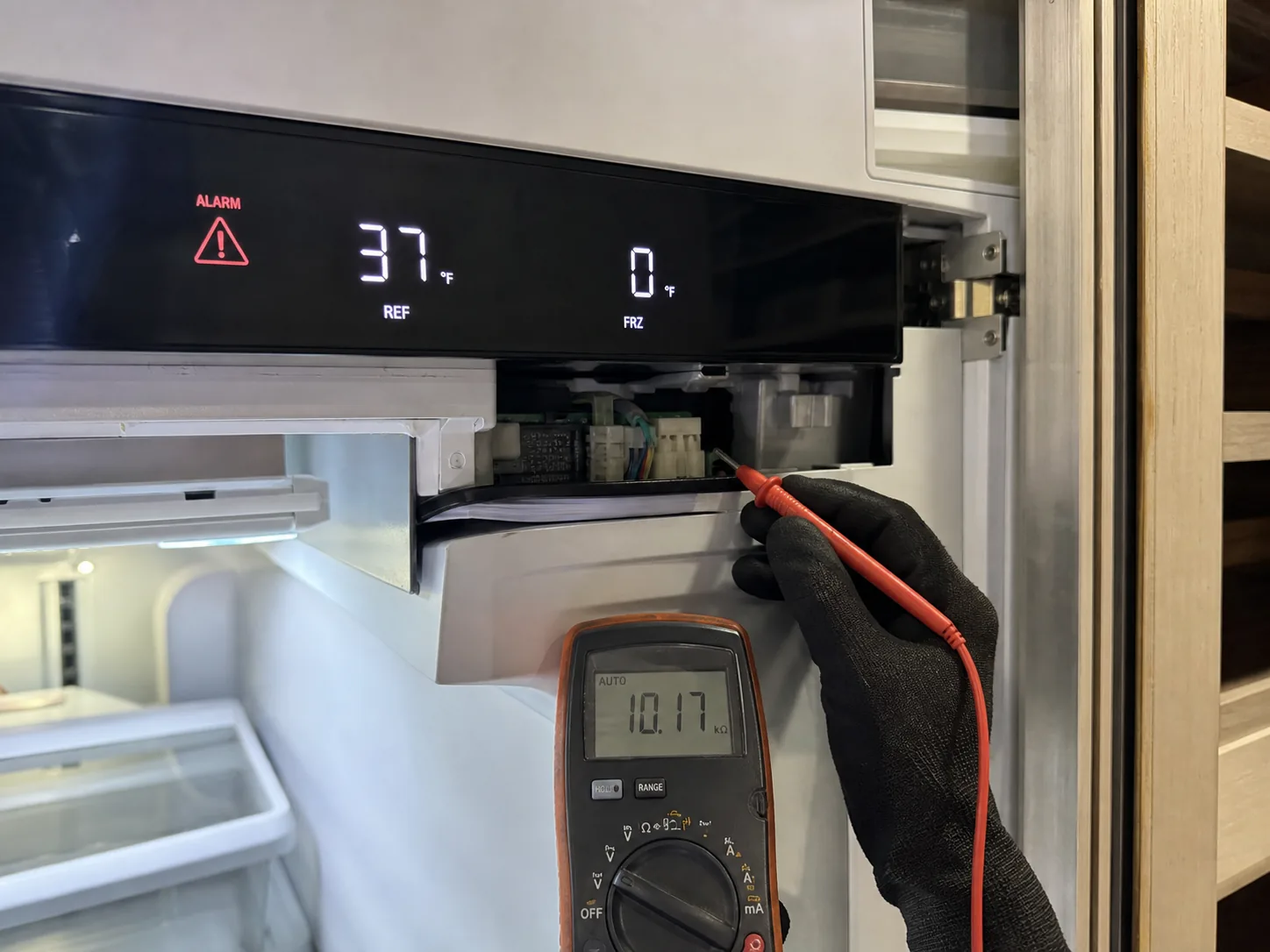
“Our 424 upper zone drifted from 55°F to 64°F during the August heat wave, scary with a serious collection in our Sharon Heights hillside estate. They metered it, replaced the zone sensor for $410, and the zone held ±2°F by the next morning. Two hours on site.”
Specialty · Wine storage
When your Sub-Zero wine column won’t hold temperature in Menlo Park
A wine column or dual-zone cabinet that drifts a few degrees is a real problem for a collection, and it often arrives alongside a control board, thermistor or display alarm flagging the zone. Out toward Woodside, where cellars and wine columns sit in homes with serious collections, even a 3–5° drift over a season is enough to worry about — so the goal is a stable, verified zone, not just a reset display.
The same diagnostic logic catches a different problem people confuse it with: a fresh-food section warm while the freezer still holds on a combined unit. In both cases a single compartment or zone is off while its neighbor is fine, which points to a zone-specific fan, sensor or damper. What a diagnosis confirms — and what you can’t tell from the panel — is whether the sensor is misreading or the zone genuinely isn’t cooling.

Not generic refrigeration
Why wine storage is its own diagnosis
Wine storage isn’t just “a colder fridge.” Sub-Zero wine units hold a tighter, more stable band, manage humidity to protect corks, and dampen vibration — and dual-zone cabinets run two independent setpoints at once. That engineering means the failure modes are specific: a zone sensor reading a degree or two off throws the whole zone, a tired fan creates warm pockets near the top, and a seal leak undoes humidity control. In Menlo Park homes where the wine unit is built into a dining or butler’s area rather than the main kitchen, airflow around the condenser is often the overlooked culprit — tight cabinetry traps heat the unit needs to reject.
Five common wine-unit failures
What drifts, why, and what changes the quote
Zone sensor / thermistor out of range
- Symptom
- Display reads correct but bottles feel warm, or one zone drifts.
- Quote factor
- Sensor part + access; usually a moderate repair.
Evaporator fan creating warm pockets
- Symptom
- Top shelves warmer than the bottom; uneven cooling.
- Quote factor
- Fan motor variant by series.
Door seal / hinge letting humidity out
- Symptom
- Condensation, dry corks risk, unit running long.
- Quote factor
- Gasket plus alignment.
Condenser airflow blocked by cabinetry
- Symptom
- Whole unit drifts warm in a tight built-in space.
- Quote factor
- Coil clean; cabinetry ventilation review.
Control board / display fault
- Symptom
- Alarms, erratic setpoint, zones not responding.
- Quote factor
- Board service after metered confirmation.
What to do now
Schedule, pause, or book service?
If the drift is small and steady, log the displayed and actual temperatures for a day and have them ready with your model tag — we can often tell you the likely cause before the visit. If the zone is climbing past the mid-50s°F for reds or warming a white zone noticeably, treat it as time-sensitive and move irreplaceable bottles to stable storage while you book. Don’t keep relocating bottles in and out repeatedly; the door cycling adds heat and humidity swings. A quick thermometer placed mid-cabinet for an hour is worth more than the panel reading alone.
Local proof
Wine units across the Peninsula
Patterns we plan around: in Sharon Heights, wine columns in wooded-lot homes often sit in cooler rooms, which masks a failing fan until summer; in Stanford Hills, newer dual-zone cabinets are built flush into millwork, so condenser airflow is the first thing we check; in Allied Arts and Felton Gables, older units in established homes more often need a sensor or gasket than a board. For a 94025 address with a built-in wine cabinet in a butler’s pantry, the access and ventilation plan is part of the quote, because a unit that can’t reject heat will drift no matter which part we replace. The trust proof is the same throughout: temperature readings, condenser/evaporator photos, model-tag proof, and the OEM fan, gasket or board fitted — the same evidence that solves an ice maker producing hollow cubes on a combined unit.
Verified, not reset
The proof behind a stable zone


Before you book
How to stabilize a drifting Sub-Zero wine zone
A 6-step check for Menlo Park collectors before a 424, 427R or 315 won’t hold ±2°F.
- Place a separate thermometer mid-cabinet in each zone and log its reading against the displayed and set temperature every few hours over 24 hours — one panel glance is not enough.
- Stop moving bottles in and out; repeated door cycling adds heat and humidity and masks the true drift you are trying to measure.
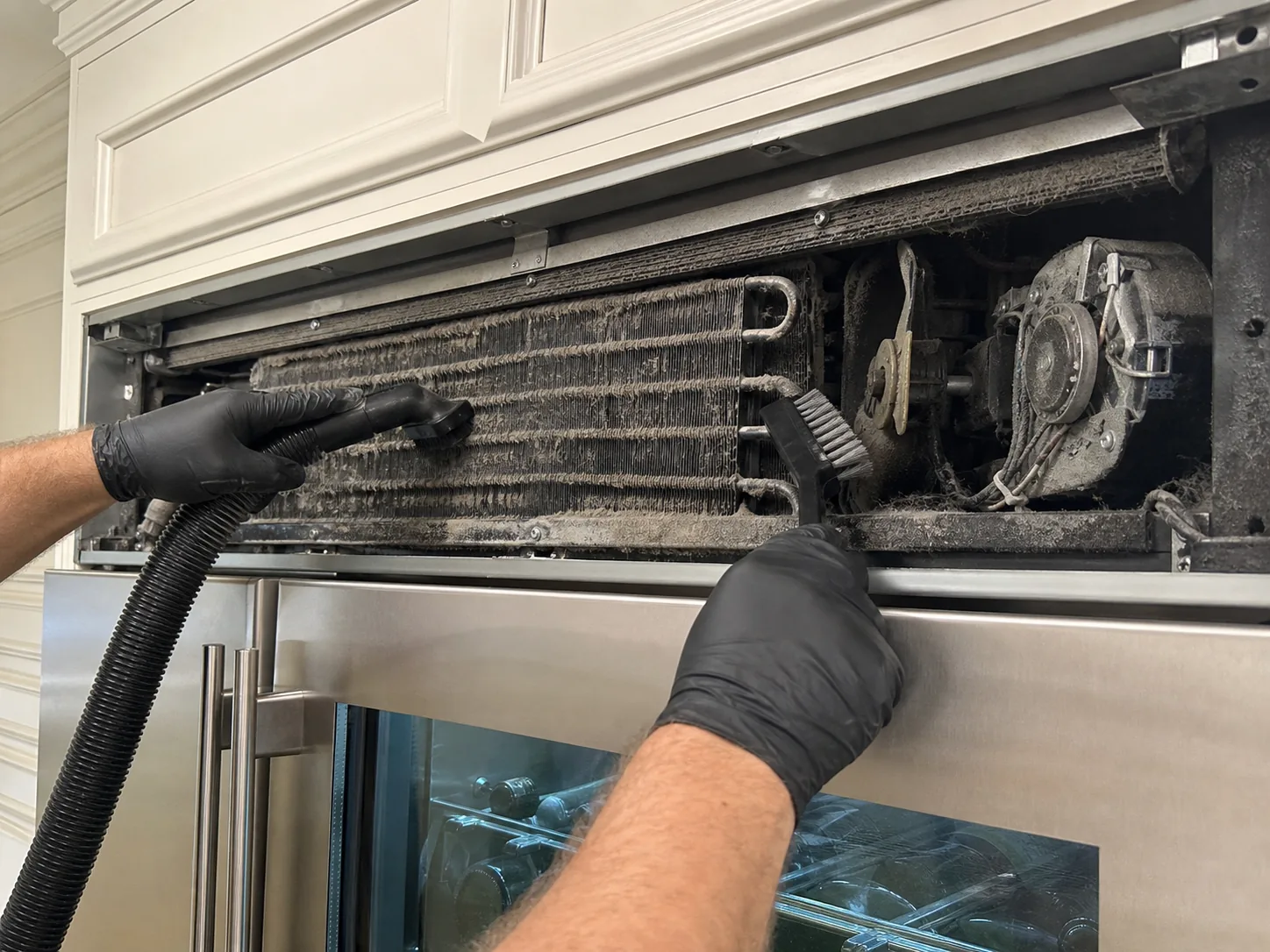
- Check the condenser grille airflow and clearance — on a built-in 424 or 427R in tight millwork, dust or a blocked grille alone can push both zones 3–5°F warm.
- Note any heat-wave timing: if the zone only climbs when Sharon Heights or Stanford Hills tops the 90s°F, the sealed system is being loaded and airflow is the first suspect.
- Inspect the door seal for gaps, condensation or a hinge that no longer pulls flush, which lets warm room air into the zone and undoes humidity control.
- If a zone still won’t hold within ±2°F of target, book service with your model tag (424, 427R or 315) and your 24-hour log so we can name the likely part before arriving.
Symptom -> cause -> price -> time
Menlo Park Sub-Zero wine unit repair costs
| Symptom | Likely cause | Planning range | Typical time |
|---|---|---|---|
| On-site diagnosis & metered reading | Diagnostic visit (credited to repair) | $110–$195 | 45–75 min |
| One zone drifting warm (424 upper) | Zone sensor / thermistor out of range | $280–$540 | 1–2 hrs |
| Zone won’t hold ±2°F | Evaporator fan or air damper | $300–$620 | 1.5–3 hrs |
| Both zones warm after a heat wave | Condenser airflow / dust-loaded coil | $190–$460 | 1–2 hrs |
| Temperature swings & alarms | Control board / UI fault | $380–$880 | 1.5–3 hrs |
| Door letting warm air into the zone | Door seal / gasket & alignment | $260–$560 | 1–2 hrs |
| Unit can’t cool the cabinet at all | Sealed-system / compressor (verified) | $1,050–$2,600 | 4–8 hrs |
On Sharon Heights hillside estates, most August heat-wave drift on a 424 or 427R is a $280–$620 sensor, fan or airflow fix — a verified sealed-system repair is rare. A Sub-Zero wine unit should hold about 55°F (dual zones roughly 45–55°F whites and 55–65°F reds); a drift of more than 3–5°F usually points to a zone sensor, fan or damper, not the compressor.
Wine storage questions
For collectors and dual-zone owners
What temperature should a Sub-Zero wine unit hold in Menlo Park?
Aim for about 55°F overall. On a dual-zone 424, the white zone runs roughly 45–55°F and the red zone about 55–65°F. We verify the actual in-cabinet reading, not just the display; holding within ±2°F of target is the goal for a collection.
Do Menlo Park summer heat waves cause wine-zone drift?
Yes. When Sharon Heights and Stanford Hills hit the 90s°F, a built-in wine column works harder to reject heat, and a tired evaporator fan or dust-loaded condenser shows up as 3–9°F of drift. Improving condenser airflow plus a fan or sensor fix ($300–$620) usually restores a tight ±2°F zone.
How many degrees of drift is actually a problem?
For a long-term collection, a steady drift of more than 3–5°F above target is worth correcting; it accelerates aging and stresses corks. That much drift almost always points to a zone sensor, fan or damper, a typical $280–$620 repair, not the sealed system or compressor.
On a dual-zone 424, why is one side warm and the other fine?
Each zone of a 424 has its own sensor, fan and air damper, so a single warm side is almost always zone-local, not the sealed system. A drifting zone sensor or thermistor runs $280–$540; a stuck damper or evaporator fan $300–$620. We meter both zones before quoting so you pay for one repair, not two.
My display reads right but the wine feels warm — why?
That points to a sensor reading out of range or a warm pocket from a weak fan. The control trusts the sensor, so if it is off, the display looks fine while the zone isn’t. A meter on the actual cabinet temperature settles it, usually a $280–$540 sensor.
How do you protect my collection during the repair?
If a zone is clearly warm, move irreplaceable bottles to stable storage first and leave the rest; avoid repeated relocation, which adds heat and humidity swings. We work cabinet-safe around the racks, meter before replacing, and aim to have the zone back within ±2°F of 55°F the same visit.

Call or book with the symptom and model ready
Log your displayed and actual temperatures, have ready them with the model tag, and we’ll tell you the likely cause before the visit.
Local reviews
Recent Menlo Park Sub-Zero service reviews
Local feedback on model-first diagnosis, clean built-in work and written pricing.
138 local reviews
“Our 427R wine column in Central Menlo Park slid from 55°F toward 62°F and wouldn’t hold. They found a failing evaporator fan, not the compressor, and replaced it for $545 in about two and a half hours. The estate’s reds are back at a steady 55°F.”
“Our 315 in a Stanford Hills millwork build crept 6°F warm once summer hit. They showed it was a dust-loaded condenser jammed in tight cabinetry, cleaned the airflow and refit the grille for $240, under an hour. Back to 55°F, no part oversold.”